Base class for Non-Stationary Gabor Filterbank Constant-Q Transform (NSGF-CQT) operations. More...
#include <CQT.hpp>
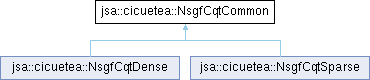
Classes | |
| struct | BandInfo |
| Holds information about the number of bands in the filterbank. More... | |
Public Member Functions | |
| NsgfCqtCommon (double sampleRate, Eigen::Index numSamples, double fraction, double minFrequency, double maxFrequency, double refFrequency) | |
| Constructor for NsgfCqtCommon. | |
| bool | isValid () const |
| True when the object is usable: the configuration passed validate() and the constructed frame passed the measured health check (see checkFrameHealth()). | |
| double | getFrameConditionNumber () const |
| Condition number of the painless frame operator, max(d)/min(d) up to Nyquist. Advisory: reconstruction error amplifies by roughly cond·ε, so values ≲ 1e6 keep double-precision round trips near 1e-10. Returns +inf when the object is invalid. | |
| double | getSampleRate () const |
| Eigen::Index | getBlockSize () const |
| Synonym of getNumSamps(). | |
| Eigen::Index | getNumSamps () const |
| Synonym of getBlockSize(). | |
| double | getFraction () const |
| double | getPpo () const |
| double | getMinFreq () const |
| double | getMaxFreq () const |
| double | getRefFreq () const |
| Eigen::Index | getNumFreqs () const |
| Eigen::Index | getNumBands () const |
| const Eigen::ArrayXd & | getFrequencyAxis () const |
| const Eigen::ArrayXd & | getBandAxis () const |
| const Eigen::ArrayXd & | getDiagonalization () const |
Protected Member Functions | |
| bool | checkFrameHealth () const |
| Measured frame-health check on the constructed frame operator. | |
Static Protected Member Functions | |
| static bool | validate (double fs, Eigen::Index nSamps, double frac, double fMin, double fMax, double fRef) |
| Checks the structural validity conditions for a configuration. | |
| static BandInfo | computeBandInfo (double frac, double fMin, double fMax, double fRef) |
| Computes band information for the filterbank. | |
Protected Attributes | |
| const bool | valid |
| Structural validity: result of validate(). | |
| bool | frameOk = true |
| Measured frame health; set by derived ctors. | |
| const double | fs |
| Sampling rate (Hz). | |
| const Eigen::Index | nSamps |
| Number of samples in a block (0 when invalid). | |
| const double | frac |
| Reciprocal of bands per octave. | |
| const double | fMin |
| Minimum frequency (Hz). | |
| const double | fMax |
| Maximum frequency (Hz). | |
| const double | fRef |
| Reference frequency (Hz). | |
| const BandInfo | bandInfo |
| Band information. | |
| const Eigen::Index | nBands |
| Total number of bands. | |
| const Eigen::Index | nFreqs |
| Number of frequencies. | |
| Eigen::ArrayXd | bax |
| Band axis. | |
| Eigen::ArrayXd | fax |
| Frequency axis. | |
| Eigen::ArrayXd | d |
| Diagonalization array. | |
| Eigen::ArrayXcd | Xdft |
| DFT of the signal. | |
| DFT | dft |
| Discrete Fourier Transform object. | |
Static Protected Attributes | |
| static constexpr double | dHealthTol = 1e-6 |
| static constexpr double | th = 1e-6 |
| static constexpr Eigen::Index | minAtomSupport = 4 |
Detailed Description
Base class for Non-Stationary Gabor Filterbank Constant-Q Transform (NSGF-CQT) operations.
This class provides common functionality and data members for NSGF-CQT operations, including frequency axis computation, band information, and diagonalization.
Construction never throws and never crashes: a configuration that fails validate() produces an inert object — isValid() returns false, the processing methods output silence, and accessors return empty data. This supports host lifecycles (e.g. DAWs) that construct with a placeholder sample rate before the real one is known; since the whole design depends on the sample rate, the correct response to a new rate is constructing a new object.
Constructor & Destructor Documentation
◆ NsgfCqtCommon()
| NsgfCqtCommon::NsgfCqtCommon | ( | double | sampleRate, |
| Eigen::Index | numSamples, | ||
| double | fraction, | ||
| double | minFrequency, | ||
| double | maxFrequency, | ||
| double | refFrequency ) |
Constructor for NsgfCqtCommon.
- Parameters
-
sampleRate Sampling rate of the signal (Hz). numSamples Number of samples in a block. fraction Reciprocal of bands per octave (e.g. 1.0/12 for 12 bands/octave); fractional values allowed. minFrequency Minimum frequency of the filterbank (Hz). maxFrequency Maximum frequency of the filterbank (Hz). refFrequency Reference frequency for the filterbank (Hz).
Member Function Documentation
◆ checkFrameHealth()
|
protected |
Measured frame-health check on the constructed frame operator.
The painless frame operator is diagonal with entries d(f); the transform is invertible iff min(d) > 0 on the covered range, and numerically trustworthy iff the condition number max(d)/min(d) is moderate. Requiring min(d) > dHealthTol·max(d) bounds the condition number by 1/dHealthTol. Called by the derived constructors once d is available; every "Q too high for this block" failure mode lands here, whatever combination of parameters caused it.
◆ computeBandInfo()
|
staticprotected |
Computes band information for the filterbank.
- Parameters
-
frac Reciprocal of bands per octave. fMin Minimum frequency of the filterbank (Hz). fMax Maximum frequency of the filterbank (Hz). fRef Reference frequency for the filterbank (Hz).
- Returns
- BandInfo Struct containing band information.
◆ isValid()
|
inline |
True when the object is usable: the configuration passed validate() and the constructed frame passed the measured health check (see checkFrameHealth()).
Two tiers on purpose: parameter rules catch the provable absurdities, but the fuzzy boundary — a convergence of factors with no closed-form criterion — is decided by inspecting the frame that was actually built, not by predicting from parameters. Two measured modes: coverage gaps (bins no atom reaches: frame-operator condition number, checkFrameHealth()) and unresolved atoms (bands too narrow for the grid: per-atom support ≥ minAtomSupport).
An invalid object is inert: forward()/inverse() write zeros to their outputs and return, and accessors return empty or unusable data. Parameter getters (getSampleRate() etc.) still report what was passed.
◆ validate()
|
staticprotected |
Checks the structural validity conditions for a configuration.
Deliberately limited to conditions under which the transform is provably meaningless: positive sample rate, power-of-two block size (a structural assumption of the per-band span logic, see NsgfCqtSparse::getIdx — independent of what a backend could handle), positive fraction and reference frequency, 0 < fMin < fMax, and fMax strictly below Nyquist. Nothing about the extent of the range is gated (sub-octave ranges are legitimate): feasibility is measured on the constructed frame instead (checkFrameHealth(), atom support).
Member Data Documentation
◆ dHealthTol
|
staticconstexprprotected |
Relative floor for the frame-operator diagonal: bounds the frame condition number by 1e6, keeping double-precision round trips ~1e-10.
◆ minAtomSupport
|
staticconstexprprotected |
Minimum number of bins above th an atom must occupy to count as resolved by the frequency grid. The fuzzy "Q too big for the block" failure mode is invisible in d — with many bands per octave every bin is still covered — so it is caught from the atom side instead: unresolved atoms are the measured, warp-agnostic equivalent of the parametric Q check. 4 matches the smallest FFT span getIdx will build (and min_bw in the Python reference).
◆ th
|
staticconstexprprotected |
Atom magnitude threshold: below it a bin does not count as support (and, in the sparse variant, is zeroed for efficiency).
The documentation for this class was generated from the following files:
- /home/runner/work/CiCueTea/CiCueTea/Include/CQT.hpp
- /home/runner/work/CiCueTea/CiCueTea/Source/CQT.cpp